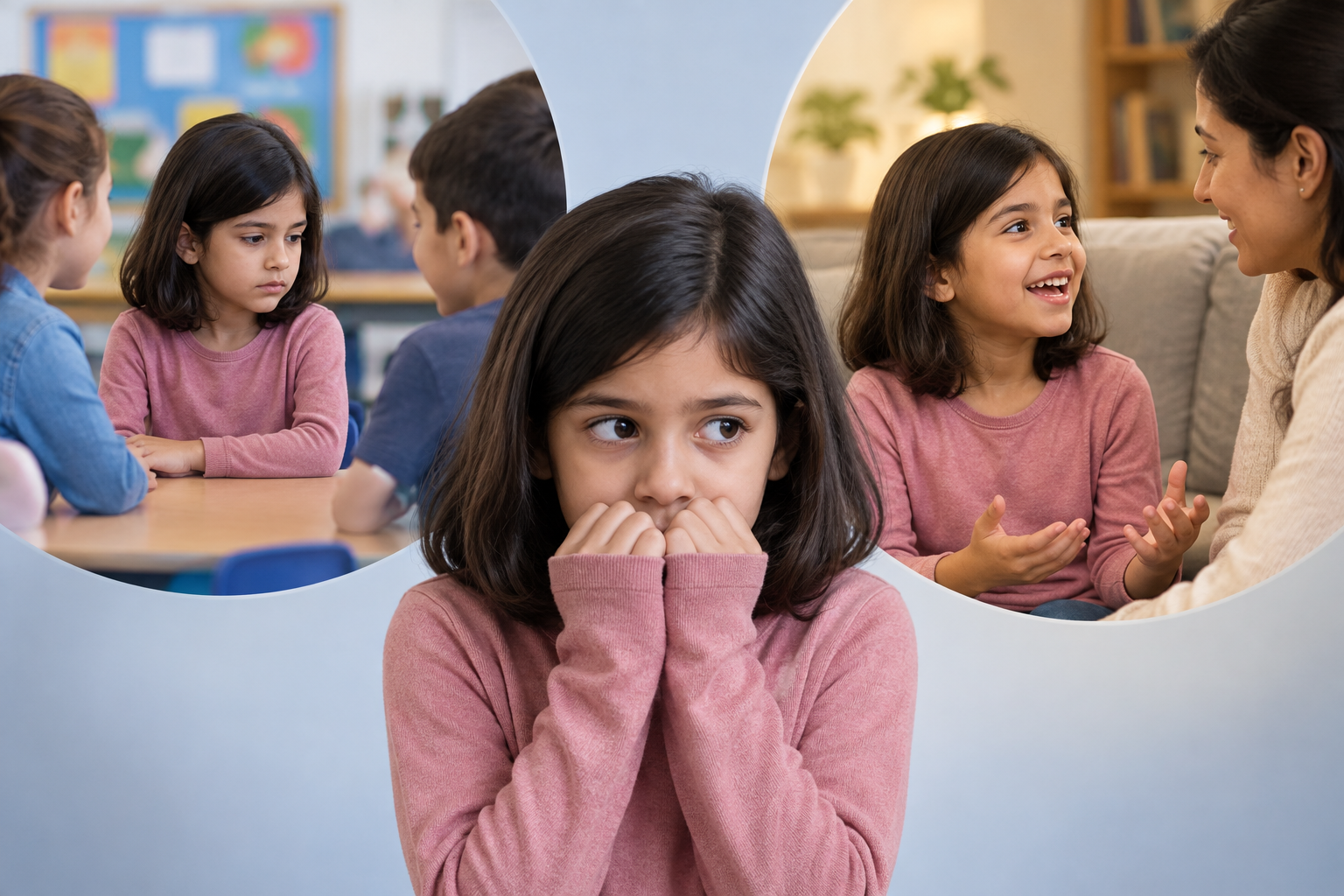
Selective mutism isn’t a speech disorder, it’s anxiety. The child goes silent in specific settings, school, an unfamiliar relative’s house, new company, while speaking normally and comfortably at home. It typically starts early, right as a child begins facing new classrooms and new faces for the first time. The silence isn’t defiance or a mood, it’s a nervous system stuck in freeze mode the moment speech feels expected somewhere unsafe.
According to Dr. Sushant D. Sarang, Occupational Therapist in Navi Mumbai at Tender Touch Therapy Clinic, “Parents often assume their child is being difficult or overly shy. What’s actually happening is the anxiety response taking over the moment speech is expected outside home. It’s not defiance. It’s fear wearing a very quiet face.”
What Are the Signs of Selective Mutism in Children?
No two kids show it exactly the same way. Still, certain patterns turn up again and again.
- Freezing in specific settings: Chatty at home, mute at school. Add unfamiliar relatives to the mix and the same shutdown happens. The switch happens instantly, not gradually.
- Physical signs of anxiety: Watch the body before the words. A stiffened posture, eyes turned away, a blank stare, or clinging tight to mom or dad, these show up right before the silence sets in. The body reacts before the mind decides anything.
- Communicating without words: A nod here, a point there, maybe a whisper to just one trusted person. Speech gets replaced with gesture, and that becomes the norm. Some children freeze entirely, movement included.
- Persistence past the first weeks: A quiet start to a new school year is normal. Selective mutism runs longer, a month or more, and it starts chipping away at schoolwork and friendships. That’s the line worth watching.
A focused behavioral therapy plan builds speech confidence right in these settings, not somewhere else.
How Is Selective Mutism Different From Normal Shyness?
Most parents wait it out first, chalking it up to shyness. But the two behave very differently underneath the surface.
Feature | Shy Child | Child with Selective Mutism |
Warms up over time | Yes, usually within minutes | No, silence persists across repeated visits |
Speaks in a new setting eventually | Yes | Rarely, without targeted support |
Body language | Slightly reserved | Frozen, anxious, sometimes rigid |
Impact on school or friendships | Minimal | Often significant |
- Time alone doesn’t fix it: A shy child eases up after a few visits to the same place. A child with selective mutism can sit through an entire term in the same classroom and still never say a word to the teacher.
- The freeze response runs deeper: Shyness feels like discomfort. Selective mutism is closer to panic. The body locks the words in, it doesn’t just hold them back.
- School performance often suffers: Teachers sometimes mistake the silence for disinterest or low ability. It’s neither. Participation and grades slip for reasons that have nothing to do with intelligence.
- Friendships take longer to build: Kids nearby read the silence as unfriendliness, though that’s rarely what’s going on. Kids with selective mutism usually want to connect. The anxiety just gets there first.
So can therapy actually shift this? Our piece on behavioral therapy sessions shows the same approach helping kids build this exact kind of confidence.
Why Choose Tender Touch Therapy Clinic?
Dr. Sushant Sarang is a PhD Scholar in Occupational Therapy, with Sensory Integration certification, from the USA, backing up the clinical side. Over 27 years in practice and 2 lakh plus sessions guided, he’s worked a large number of children carrying anxiety-driven speech difficulties like this. A team of 20+ therapists across four Navi Mumbai branches works alongside him, so a child’s plan stays consistent from one session to the next. That consistency is what makes trust with a child rebuild slowly, one interaction at a time.
Every child presenting with ADHD starts with a full assessment before any programme is designed. It identifies which specific patterns are causing the most disruption and what combination of approaches is most likely to produce change. Parents are involved from the beginning and receive guidance on carrying strategies into daily life at home. What is not working gets replaced.
Chatty at home, silent at school, does that sound like your child? A proper assessment can tell you why.
FAQs
At what age does selective mutism usually show up?
Usually between three and five, right when a child’s social world widens.
Is selective mutism a form of autism?
No. It’s an anxiety disorder, and it can exist with or without autism.
Will selective mutism go away without therapy?
Some kids improve on their own, but therapy speeds things up and prevents relapse.
How long does treatment usually take?
Depends on the child, but most parents see progress within a few months.
- PMC — Selective Mutism: A Review of Etiology, Comorbidities, and Treatment: https://pmc.ncbi.nlm.nih.gov/articles/PMC2861522/
- PMC — Children of Few Words: Relations Among Selective Mutism, Behavioral Inhibition, and Social Anxiety Symptoms: https://pmc.ncbi.nlm.nih.gov/articles/PMC4712224/
Disclaimer: This blog is for informational purposes only and is not a substitute for professional medical advice.