Watching a child learn to sit, crawl, walk, run and eventually climb and jump is an exciting part of growing up. These everyday movements are supported by gross motor skills, which involve the large muscles of the body, including the legs, arms, back and core.
Gross motor development does not look exactly the same for every child. Some children may master certain movements earlier, while others may take more time. However, persistent delays in movement, balance or coordination can sometimes indicate that a child may need additional support.
Understanding gross motor milestones and possible delays can help parents support their child’s development without turning everyday play into a source of pressure.
Gross motor skills help children move, play, and become more independent. Early support can make a meaningful difference when a child struggles with movement or coordination.”— Dr. Sushant Sarang
Why Are Gross Motor Skills Important?
Gross motor skills give children control over their larger body movements — and they are behind many everyday activities, from climbing out of bed in the morning to running around the playground after school.
Strong gross motor skills can help children:
- Maintain balance and body control
- Walk, run, jump and climb safely
- Join in on playground games and sports
- Build strength and coordination
- Move through their environment with confidence
- Take part in play that suits their age
- Manage everyday activities more independently
Movement also opens up the world around them. A child who can climb, squat, balance and get around comfortably will usually find it easier to jump into games with other kids — rather than hanging back on the sidelines.
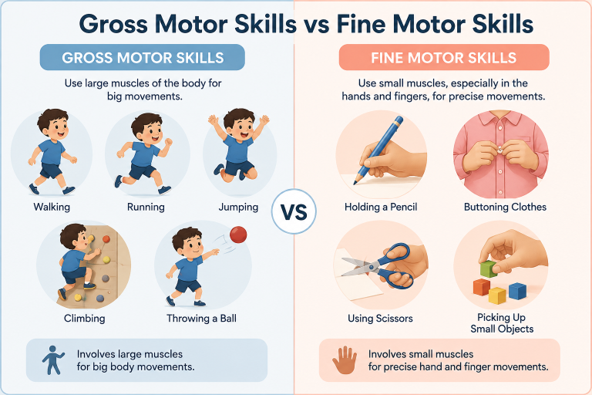
Gross Motor Skills vs Fine Motor Skills
Gross Motor Skills Milestones by Age
Keep in mind that every child moves at their own pace — these milestones are general markers, not strict checkpoints. How a child is developing overall usually tells you more than how they’re doing on any one skill.
Infants: Babies slowly gain control of their head and neck, learn to roll over, sit more steadily, and eventually start finding ways to move around on their own.
Around 1 year: This is often when children start pulling themselves up, standing while holding onto something, and taking those first wobbly independent steps.
Around 2 years: Walking becomes more confident, and many children start running, climbing and kicking a ball around this stage.
Around 3 years: Balance and coordination keep improving. Children may start jumping, tackling stairs with more confidence, and getting more involved in active games.
Around 4–5 years: Coordination tends to come together for running, jumping, hopping, throwing and catching. Many children can also balance on one foot and handle playground equipment more confidently.
There’s a lot of natural variation from one child to the next so if something’s on your mind about your child’s development, it’s better to talk it through with a qualified professional than to measure them against other kids.
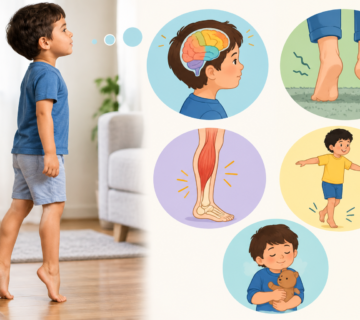
Signs of Gross Motor Delay in Children
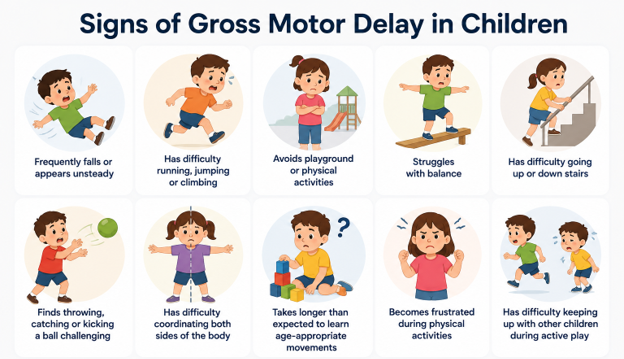
One sign on its own does not necessarily mean there is a developmental problem. What matters is whether difficulties are persistent and affect the child’s daily activities, play or independence.
Concerned about your child’s movement or coordination? A professional assessment can help identify their strengths and support their development.
How Occupational Therapy Can Help With Gross Motor Skills
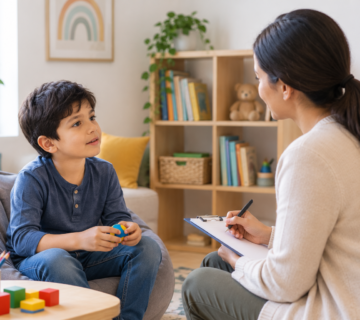
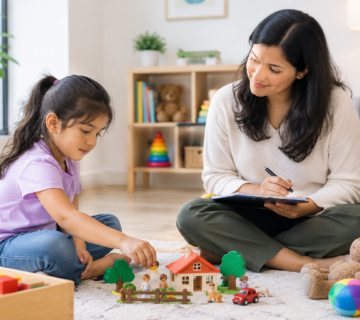
When a child keeps struggling with movement, an Occupational Therapist (OT) doesn’t just look at one skill in isolation they look at how that difficulty shows up in the child’s everyday life.
An assessment might cover things like:
- Balance and coordination
- Body awareness
- Motor planning
- Postural control
- Strength and movement
- Sensory processing
- How the child participates in play and daily activities
From there, the therapist puts together a plan built around that particular child — their needs, their abilities, what’s actually going to help.
A lot of the work happens through play. Kids practise movement, coordination, balance and motor planning in ways that feel like fun rather than a task to get through.
And it’s worth saying occupational therapy isn’t about getting every child to hit the same milestone at the same age. It’s about helping a child feel more comfortable and confident doing the things that matter to them.
Conclusion
Gross motor skills are a big part of how children grow — helping them move confidently, join in on play and become more independent along the way.
Every child develops at their own pace. Still, ongoing trouble with balance, coordination, running or jumping is worth paying attention to. Catching it early gives parents a clearer sense of what their child needs, and whether extra support could help.
Most of all, movement should stay fun. With encouragement, plenty of active play and the right guidance when needed, kids can keep building both their physical skills and their confidence.
Is your child struggling with balance or coordination? A developmental assessment can help identify their needs and support their progress.
FAQs
What are gross motor skills in children?
Gross motor skills are the big movements that come from the large muscles walking, running, jumping, climbing, balancing and throwing.
What is the difference between gross motor and fine motor skills?
Gross motor skills involve big, whole-body movements. Fine motor skills are the smaller, more precise ones, mainly using the hands and fingers.
What are some gross motor activities for children?
Running, dancing, climbing, ball games, obstacle courses, hopping and balance games are all simple ways to build gross motor skills through play.
When should I be concerned about my child's gross motor skills?
Children develop at different paces, but if your child often struggles with age-appropriate movements, falls frequently, avoids physical play, or has trouble with balance and coordination, it’s worth speaking to a professional.
Can Occupational Therapy help with gross motor skills?
Yes. An Occupational Therapist can work on coordination, balance, motor planning and body awareness, with a plan tailored to your child’s needs.
References
- https://my.clevelandclinic.org/health/articles/gross-motor-skills
- https://help-for-early-years-providers.education.gov.uk/areas-of-learning/physical-development/gross-motor-skills
Disclaimer: This blog is for informational purposes only and is not a substitute for professional medical advice.