Four years is a significant period in terms of development, where the child becomes more talkative, inquisitive, independent, and capable of doing physical activities like running and jumping, as well as playing in groups and drawing.
Since each child develops at their own pace, it is quite natural to have some variations. The main thing that should be observed is the general development in the following fields: speech development, motor development, fine motor development, social development, and emotional development.
As Dr. Sushant Sarang explains, “Development is not about every child reaching the same milestone at exactly the same age. It is about understanding a child’s individual strengths and supporting the areas where they may need help.”
Knowing the typical 4-year-old developmental milestones can help parents understand what to expect and when it may be worth seeking extra support.
What Are Developmental Milestones at Age 4?
Developmental milestones are the skills most children tend to pick up around a certain age. They cover several areas of development, including:
- Speech and language
- Gross motor skills
- Fine motor skills
- Social and emotional development
- Thinking and problem-solving
- Independence in everyday activities
By age four, many children are growing more confident and capable across all these areas, even if the pace looks a little different from one child to the next.
4-Year-Old Speech and Language Milestones
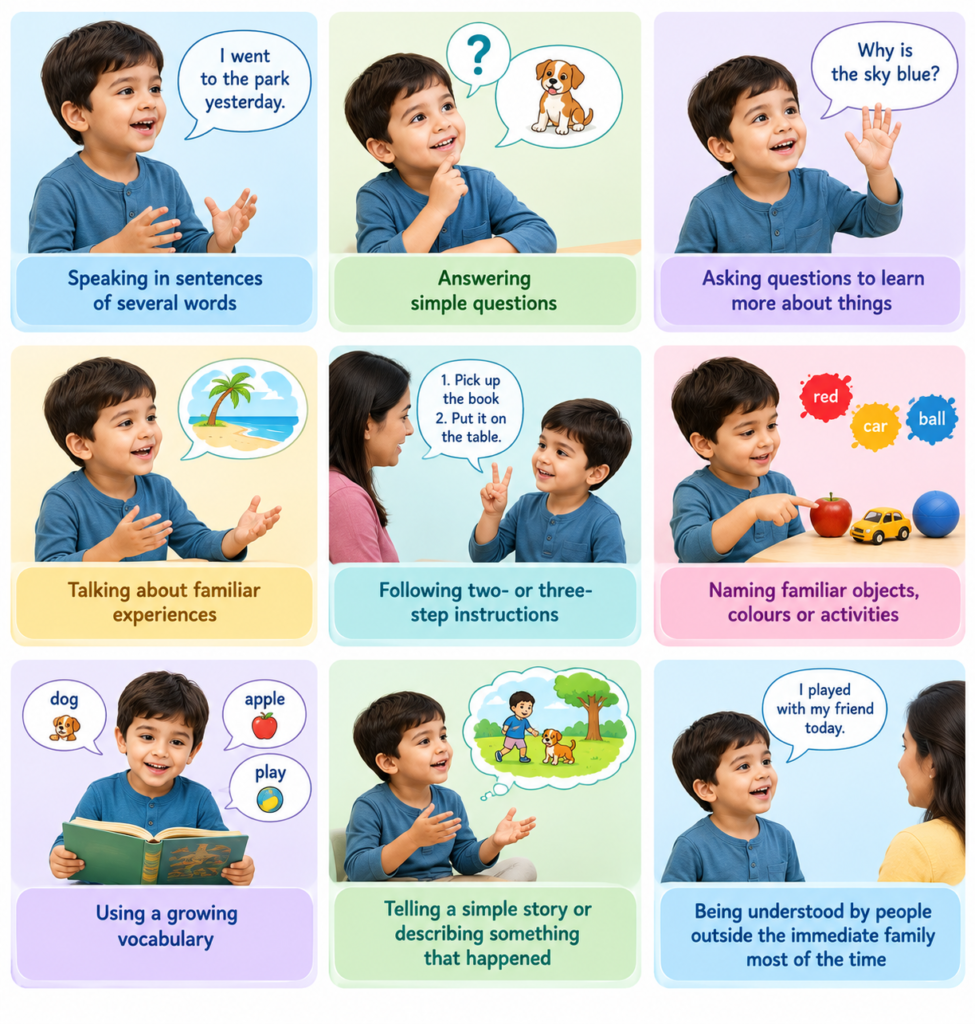
There are rapid changes in speech and language development from 3 to 4 years. At this age many children are able to express their needs and have a conversation with others, talking about what has happened to them during the day.
At four years of age, some children achieve the following speech and language skills:
At four, many kids are chatty little storytellers, full of “why?” questions and imaginative tales. Some speech sounds are still developing, but if your child is hard to understand, rarely speaks in full sentences, struggles to follow instructions, or has trouble expressing their needs, it’s worth bringing up with a professional.
4-Year-Old Gross Motor Milestones
Gross motor skills involve the bigger movements of the arms, legs, and core. They’re what let kids race around the playground, climb, jump, and dive into active play.
Around age four, many children can:
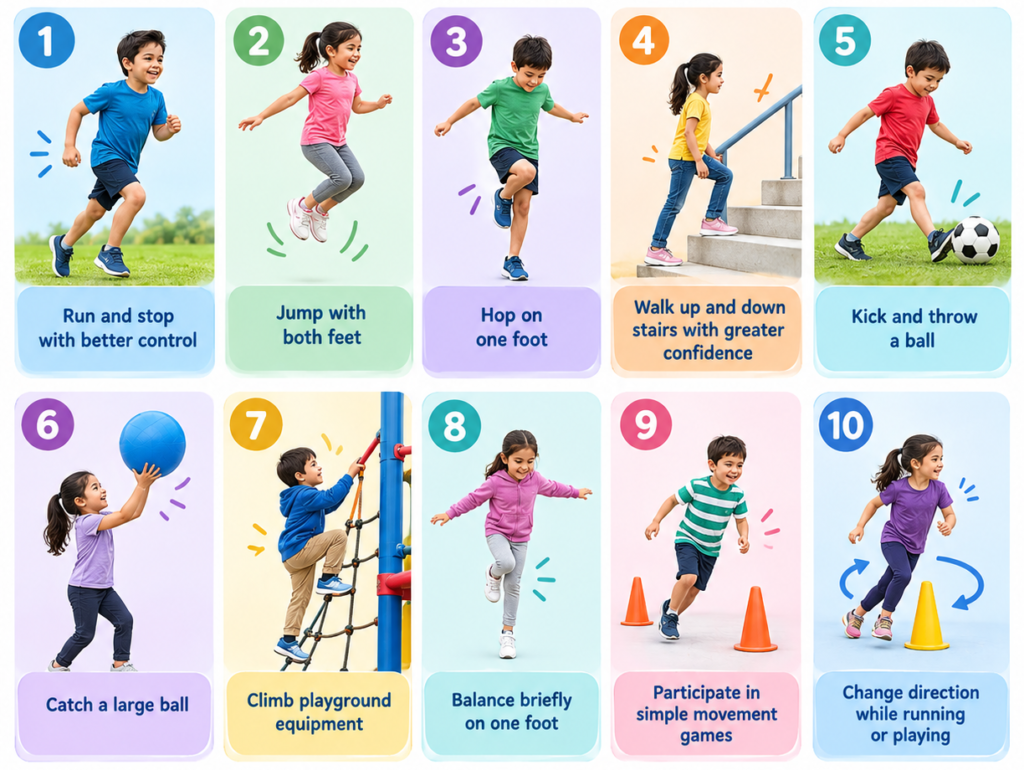
These skills grow naturally through everyday movement and play. Things like running, jumping, climbing, dancing, and playing with a ball all help build a child’s gross motor development.
4-Year-Old Fine Motor Milestones
Fine motor skills are the smaller, more precise movements of the hands and fingers. In the classroom, they come into play with activities like drawing, using scissors, eating, getting dressed, and handling small objects.
By age 4, many children are developing the ability to:
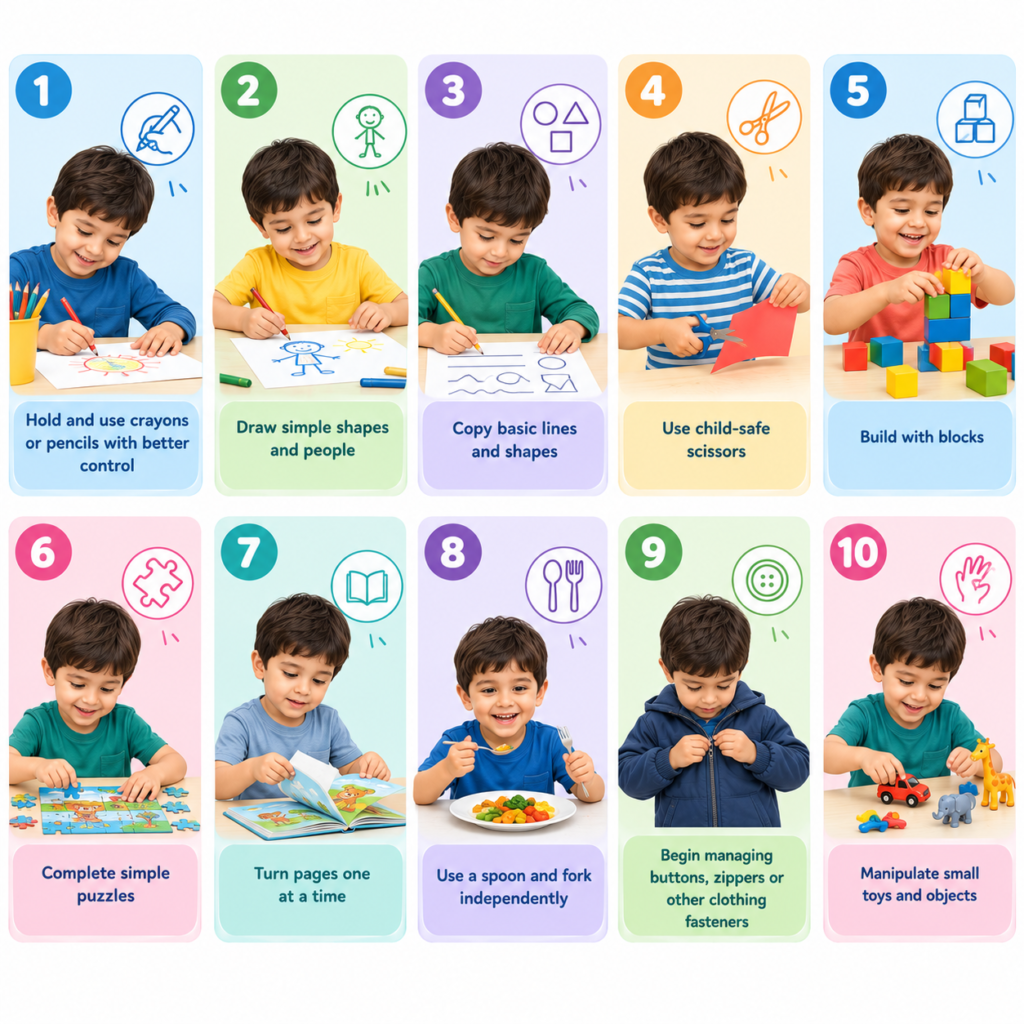
Fine motor skills play a big role in school readiness and everyday independence. Activities like coloring, drawing, playdough, puzzles, threading, and building help strengthen hand control and coordination.
Remember: Progress matters more than perfect independence at age 4.
Social and Emotional Milestones at 4 Years
Kids this age start showing more interest in playing with others—taking turns, sharing toys, and following simple game rules, though they’ll often still need a bit of adult guidance along the way.
Common milestones include:
- Playing alongside and with other children
- Showing interest in friendships
- Taking turns, with support
- Following simple game rules
- Expressing a range of emotions
- Showing affection toward familiar people
- Starting to recognize how others might feel
- Developing pretend-play skills
- Becoming more independent with daily routines
Emotional regulation is still developing at this stage. A four-year-old might know exactly how they’re feeling but not yet know what to do about it.
4-Year-Old Developmental Milestones
Here is a simple 4-year-old developmental milestones checklist for parents:
Area | Skills many 4-year-olds may be developing |
Speech & language | Speaks in sentences, answers questions, tells simple stories |
Gross motor | Runs, jumps, hops, climbs and throws a ball |
Fine motor | Draws, colours, uses scissors and builds with blocks |
Social skills | Plays with others, takes turns and follows simple game rules |
Emotional skills | Expresses feelings and is beginning to manage emotions |
Independence | Helps with dressing, eating and simple daily routines |
Thinking skills | Understands simple instructions, sorts objects and solves simple problems |
This checklist is meant to give parents a general idea of what to look for. Children can develop at different rates, and one missed skill does not automatically mean there is a developmental delay.
What is more important is whether your child is learning, participating and becoming more independent over time.
When Should You Be Concerned About Your 4-Year-Old's Development?
Parents often wonder whether a particular behaviour is simply part of growing up or something worth looking into.Occupational therapy can help children develop positive behaviours, improve social skills, and manage everyday challenges when extra support is needed.
Consider speaking with a healthcare or developmental professional if your 4-year-old:
- Is difficult for most people to understand when speaking
- Has very limited speech or struggles to communicate needs
- Has difficulty following simple instructions
- Frequently falls or has significant difficulty with balance
- Avoids running, jumping, climbing or other age-appropriate physical play
- Has ongoing difficulty using crayons, scissors or other age-appropriate tools
- Needs significantly more help with everyday tasks than expected
- Has difficulty interacting or playing with other children
- Has very strong reactions to everyday sounds, textures, movement or touch
- Has lost a skill they previously had
One concern does not always mean a developmental delay. But if difficulties with communication, play, learning, movement, or daily activities continue, it is worth discussing with a professional.
Early assessment can help you understand your child’s needs and identify the right support.
Concerned about your child’s development? A developmental assessment can help you understand their strengths, identify areas that may need support and plan the next steps.
FAQs
What should a 4-year-old be able to do?
Most four-year-olds are able to speak in sentences, respond to directions, hop, run, and climb, draw simple shapes, participate in pretend play, and become more independent in their daily routines. Development varies from child to child, and so developmental milestones serve as guidelines only.
How well should a 4-year-old speak?
A 4-year-old can usually communicate using sentences and take part in simple conversations. They can ask questions; relate familiar experiences and simple stories. Speech is likely to be understandable to outsiders of the family, though some speech sounds may still be developing.
Should a 4-year-old be able to dress themselves?
Many 4 year old children are able to self help with some items of clothing (putting them on or taking them off) on their own. They might require assistance with buttons, zippers, shoes, or more challenging clothing. Independence comes in a progressive manner.
What are signs of developmental delay at age 4?
It may be manifested by barely being able to communicate, be understood, follow instructions, run and jump, use hands for age-appropriate activities, interact with other children or manage daily activities. When a child, who used to be able to do something, loses that ability, it is another reason to get professional help.
1.PMC — Interventions for Idiopathic Toe Walking (Cochrane Review): https://pmc.ncbi.nlm.nih.gov/articles/PMC6778693
2.PMC — A Caregiver Survey on Medical and Behavior Analytic Treatments for Idiopathic Toe Walking: https://pmc.ncbi.nlm.nih.gov/articles/PMC11904036
Disclaimer: This blog is for informational purposes only and is not a substitute for professional medical advice.