
What Is Behavioral Therapy and How Does It Work?

What Is Behavioral Therapy and How Does It Work?

Behavioral therapy for children is structured and action-focused. It looks at which learned behaviours are working against a child, then teaches new responses to take their place. The aim isn’t to control the child. It’s to build workable habits for home, school and friendships.

According to Dr. Sushant D. Sarang, Occupational Therapist at Tender Touch Therapy Clinic, Navi Mumbai, “Behavioral therapy starts from one idea. Behaviour is learned, so it can be relearned. Punishment rarely works. Instead, you find out what the child gets from the behaviour, or what they’re avoiding, and help them find a better way to meet that need.”

How Does Behavioral Therapy Work for Children?


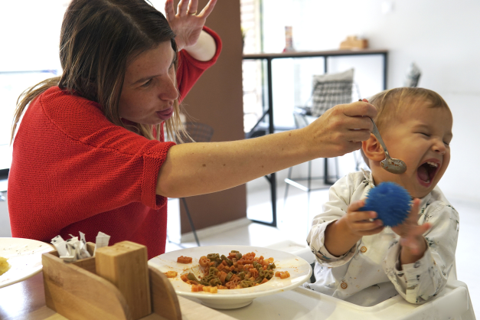
So what does behavioural therapy for kids involve? Mostly watching, planning and practising.

  • Assessment comes first: Before any plan, the therapist maps what the child does, when it happens and what sets it off. Strengths count too, not just problems.
  • Small, clear goals: “Behave better” is too vague to work with. “Ask for a break instead of throwing the pencil” is something a child can actually do.
  • Practice and reinforcement: Sessions are structured but interactive. A wanted behaviour gets noticed straight away, and the child rehearses it until it stops feeling forced. It takes repetition.
  • Parents carry it forward: Home practice plays a big part. Parents learn how to respond so new habits can stick, and regular reviews adjust the plan as the child changes.

That’s the structure behind the clinic’s behavioral therapy sessions, adjusted to each child’s age and needs.

For information about behavioral therapy options, you can contact the clinic at +91 96193 44305.

Which Concerns Can Behavioral Therapy Help With?

The list is longer than most parents expect.

Concern

What Parents May Notice

What Therapy Works On

ADHD and attention difficulties

Can’t finish tasks, acts before thinking

Attention, impulse control and task completion

Anxiety, fears and phobias

Avoids situations, clings, worries a lot

Facing fears in small steps, calmer responses

Emotional outbursts and anger

Frequent meltdowns, low frustration tolerance

Naming feelings and choosing calmer responses

Autism-related challenges

Rigid routines, repetitive or disruptive habits

Communication, daily routines and adaptive behaviour

  • ADHD and attention difficulties: The goal isn’t a quieter child. It’s one who can finish homework before bedtime and stop to think once in a while.
  • Anxiety, fears and phobias: Avoidance feels safe, so it grows. Therapy has the child face the fear in small steps instead, and the fear often eases.
  • Emotional outbursts and anger: A meltdown is often a skill gap, not bad character. Children learn to spot the build-up and pick a calmer response. Slowly.
  • Autism-related challenges: The focus is everyday life, meaning routines, communication and fewer disruptive habits. Progress may show up at home and school, not only in sessions.

For a closer look at how behavioural therapy may help children with ADHD, read our post on therapy for ADHD.

What Determines the Right Behavioral Therapy Approach?

The choice depends on the individual child. The therapist first looks at what the child does, when it happens and what triggers it. Age, the nature of the concern and how much it affects home and school then shape the goals. Parent guidance often leads in younger children, while older ones may take to cognitive behavioral therapy adapted for children. Regular reviews keep the plan in step with the child


Key Takeaways:

Behavioral therapy aims to replace habits that aren’t working with ones that are, using small goals, practice and parent involvement. It starts with an assessment of what the child does and why, and the plan is reviewed regularly. Whether it suits a particular child depends on the individual case, so it’s best discussed with a specialist. Parents play a big part in making new habits stick.

For information about behavioral therapy options, you can contact the clinic at +91 96193 44305.

FAQs

What age is play therapy for?

 Usually between three and five, right when a child’s social world widens.

 No. It’s an anxiety disorder, and it can exist with or without autism.

 Some kids improve on their own, but therapy speeds things up and prevents relapse.

Depends on the child, but most parents see progress within a few months.


  1. PMC — An Overview of Play Therapy: https://pmc.ncbi.nlm.nih.gov/articles/PMC8812369/
  2. PMC — Play Therapy: https://pmc.ncbi.nlm.nih.gov/articles/PMC2695756/ 

Disclaimer: This blog is for informational purposes only and is not a substitute for professional medical advice.
B1920f6c 9f74 42cf 8ae2 8143dbac29ab 900x500

Developmental Delays in Children: Signs, Causes & Support

Every parent has that moment of comparing notes whose baby started walking first, who said their first word earliest, who’s already climbing the furniture. It’s natural to keep an eye on how your child is growing compared to others. But development isn’t a race, and most children reach the same milestones at slightly different times without anything being wrong.

That said, there’s a difference between “taking a bit longer” and a delay that’s worth looking into. Knowing what to watch for  and when to actually raise it with someone  can save parents a lot of unnecessary worry, or help them get support sooner if it’s needed.

“Development isn’t a race. Every child has their own pace, but noticing persistent difficulties early can help families get the right support when it matters.”— Dr. Sushant Sarang,


Developmental Milestones: What Should Parents Look For?

Developmental milestones are skills children usually develop as they grow, such as smiling at a caregiver, sitting without support, saying their first words or holding a crayon. Children may progress at different rates and can be ahead in one area while needing more time in another.

Parents and professionals generally look at five key areas:

  • Motor skills – Crawling, walking, climbing, grasping and using objects
  • Speech and language – Babbling, talking, understanding and following instructions
  • Cognitive skills – Learning, remembering and solving simple problems
  • Social and emotional skills – Responding to others, making eye contact and playing
  • Self-help skills – Eating, dressing and using the toilet independently

Milestones are helpful guidelines, not strict deadlines. Being a little late with one skill doesn’t always mean something is wrong. What matters is whether the child continues to gain new skills or faces ongoing difficulties in one or more areas.

Signs of Developmental Delay in Children

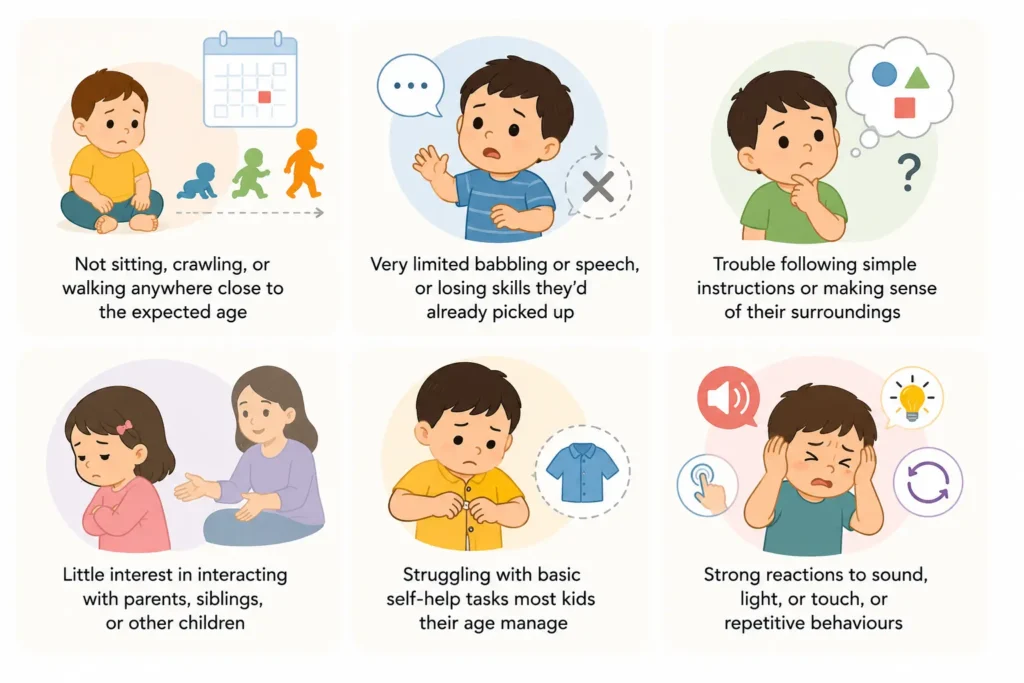
A single missed milestone rarely means much by itself. What tends to raise a flag is a child falling behind in more than one area, or a gap that sticks around for months instead of closing.

Some things worth watching for:

If a few of these sound familiar, it doesn’t mean there’s a diagnosis waiting. But it’s reason enough to talk to a paediatrician or developmental specialist rather than wait it out.

82aed4ce aa30 43c0 9a9a 371116ba4cda 1024x683

Concerned your child might be falling behind on their milestones? A professional developmental assessment can give you clarity and a clear next step.

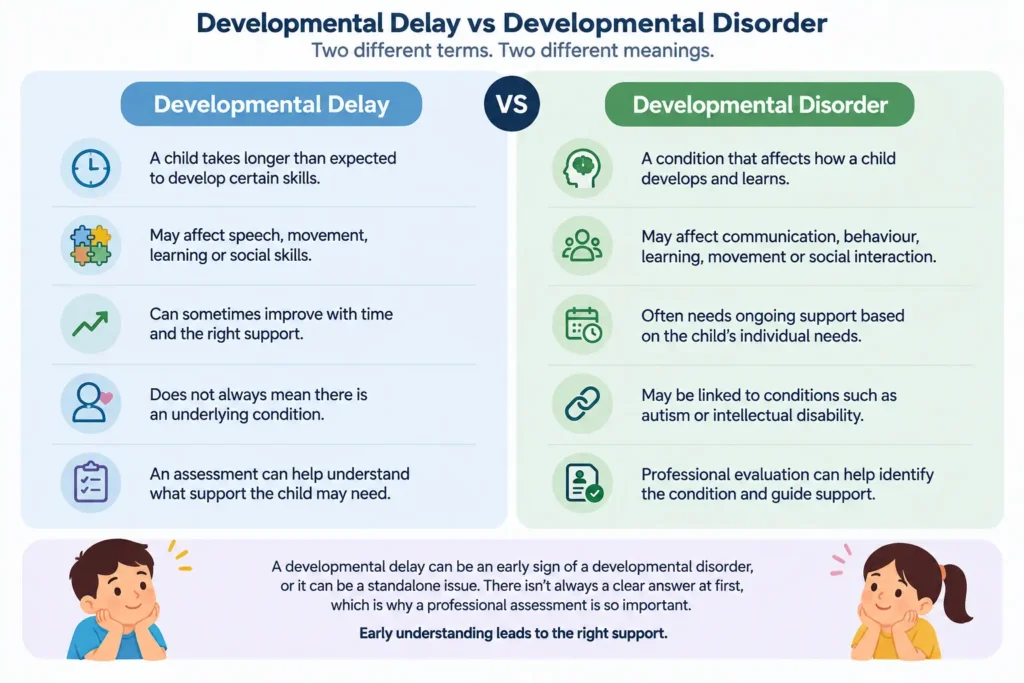
Developmental Delay vs Developmental Disorder: What's the Difference?

4ae7623a f709 4bef b5dc 93e31ceb8d14 1024x683

A developmental delay means a child takes longer than expected to develop certain skills or reach developmental milestones.

How Are Developmental Delays Assessed?

There isn’t one test that settles it. Assessment is usually a process, drawn from a few sources:

  • Developmental screening – a paediatrician checks a child’s skills against expected milestones at routine visits, often with a short questionnaire
  • Observation of play and behaviour – how a child moves, communicates, and interacts often says more than any single test
  • Standardised developmental tests – specialists use these to compare a child’s skills against age norms more precisely
  • Input from parents – what you’ve noticed at home genuinely matters, not just a box to tick
  • Referral to specialists – depending on what turns up, this could mean a speech-language therapist, a psychologist, or an occupational therapist

How Occupational Therapy Can Help Children With Developmental Delays

When a delay does need support, occupational therapy is often a sensible place to start. Rather than zeroing in on a single skill, it looks at how a child is coping with day-to-day life as a whole.

An occupational therapist typically assesses:

  • Motor coordination and body awareness
  • Sensory processing and regulation
  • Attention, focus, and self-control
  • Play skills and social interaction
  • Independence with everyday tasks like dressing, eating, or using the toilet

The therapist creates a plan based on the child’s needs and interests. Much of the work happens through play, helping children build coordination, focus and confidence in a fun, natural way.

Conclusion

Development is not a linear process and a slow beginning in one area does not necessarily indicate a problem. However, if a delay becomes noticeable in more than one skill, or if it does not resolve over time, then it’s time for a complete examination.

Early assessment is not a hurry to diagnose the process, it’s an understanding of what is happening and what help, if needed, would be useful. Most children make real progress and parents have a better understanding of what comes next with the right guidance.

Wondering if your child’s development needs a closer look? A developmental assessment can help you understand where they stand and what support could help.

FAQs

What counts as a developmental delay in a child?

It means a child is taking longer than most kids their age to reach certain skills  movement, talking, thinking, social skills, or everyday tasks.

Not exactly. A delay can narrow or close with time. A disorder tends to be longer-lasting. One can sometimes lead to the other.

If more than one area seems behind, or a single delay hasn’t budged in several months, it’s worth raising with a paediatrician.

Usually through a mix of screening, watching how the child plays and behaves, some testing, and what parents have noticed at home.


Yes. It works on movement, sensory response, focus, and independence, built around play to suit the child.

References

https://my.clevelandclinic.org/health/diseases/14814-developmental-delay-in-children

https://www.ncbi.nlm.nih.gov/books/NBK562231/

Disclaimer: This blog is for informational purposes only and is not a substitute for professional medical advice.
4-Year-Old Developmental Milestones: What Should Your Child Be Able to Do?

Four years is a significant period in terms of development, where the child becomes more talkative, inquisitive, independent, and capable of doing physical activities like running and jumping, as well as playing in groups and drawing.

Since each child develops at their own pace, it is quite natural to have some variations. The main thing that should be observed is the general development in the following fields: speech development, motor development, fine motor development, social development, and emotional development.

As Dr. Sushant Sarang explains, “Development is not about every child reaching the same milestone at exactly the same age. It is about understanding a child’s individual strengths and supporting the areas where they may need help.”

Knowing the typical 4-year-old developmental milestones can help parents understand what to expect and when it may be worth seeking extra support.

What Are Developmental Milestones at Age 4?

Developmental milestones are the skills most children tend to pick up around a certain age. They cover several areas of development, including: 

  • Speech and language
  • Gross motor skills
  • Fine motor skills
  • Social and emotional development
  • Thinking and problem-solving
  • Independence in everyday activities

By age four, many children are growing more confident and capable across all these areas, even if the pace looks a little different from one child to the next.

4-Year-Old Speech and Language Milestones

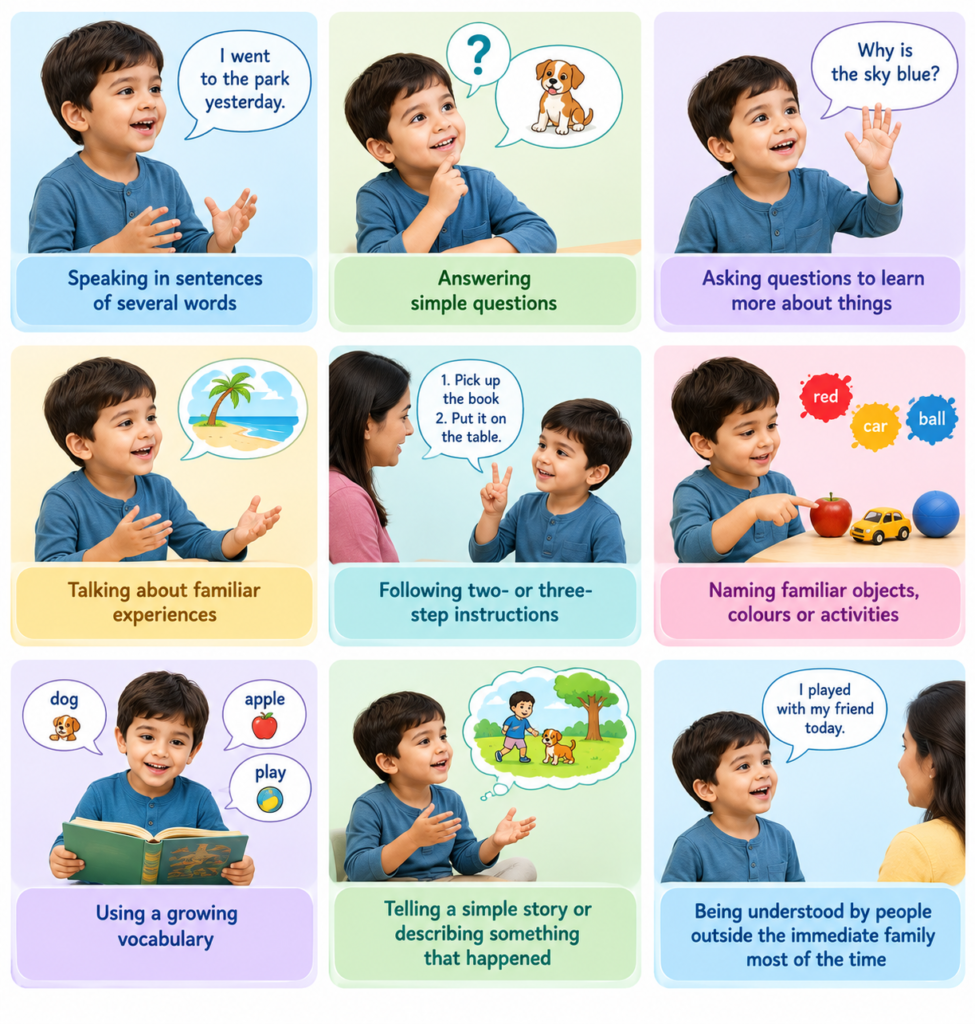
There are rapid changes in speech and language development from 3 to 4 years. At this age many children are able to express their needs and have a conversation with others, talking about what has happened to them during the day.

At four years of age, some children achieve the following speech and language skills: 

At four, many kids are chatty little storytellers, full of “why?” questions and imaginative tales. Some speech sounds are still developing, but if your child is hard to understand, rarely speaks in full sentences, struggles to follow instructions, or has trouble expressing their needs, it’s worth bringing up with a professional.

Image2 975x1024

4-Year-Old Gross Motor Milestones

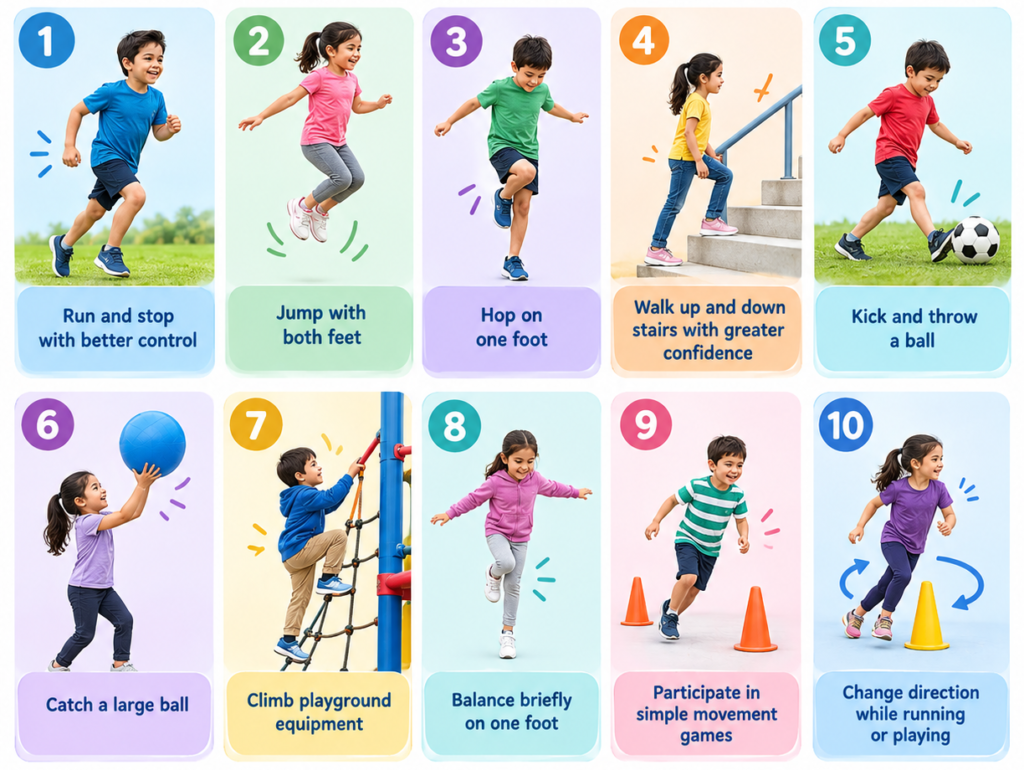
Gross motor skills involve the bigger movements of the arms, legs, and core. They’re what let kids race around the playground, climb, jump, and dive into active play.

Around age four, many children can:

Image4 e1791264344433 1024x770

These skills grow naturally through everyday movement and play. Things like running, jumping, climbing, dancing, and playing with a ball all help build a child’s gross motor development. 

4-Year-Old Fine Motor Milestones

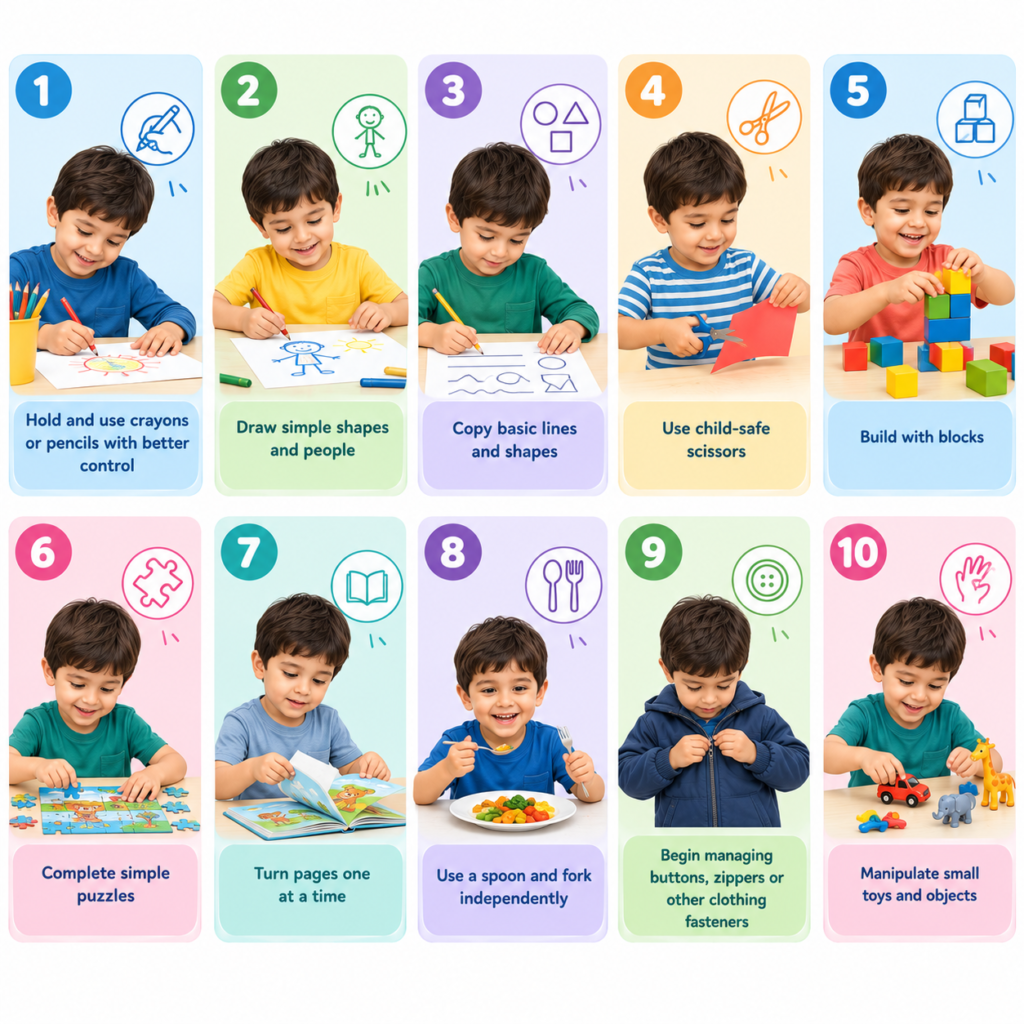
Fine motor skills are the smaller, more precise movements of the hands and fingers. In the classroom, they come into play with activities like drawing, using scissors, eating, getting dressed, and handling small objects.

By age 4, many children are developing the ability to:

Image1 1024x1024

Fine motor skills play a big role in school readiness and everyday independence. Activities like coloring, drawing, playdough, puzzles, threading, and building help strengthen hand control and coordination. 

Remember: Progress matters more than perfect independence at age 4.

Social and Emotional Milestones at 4 Years

Kids this age start showing more interest in playing with others—taking turns, sharing toys, and following simple game rules, though they’ll often still need a bit of adult guidance along the way.

Common milestones include:

  • Playing alongside and with other children
  • Showing interest in friendships
  • Taking turns, with support
  • Following simple game rules
  • Expressing a range of emotions
  • Showing affection toward familiar people
  • Starting to recognize how others might feel
  • Developing pretend-play skills
  • Becoming more independent with daily routines

Emotional regulation is still developing at this stage. A four-year-old might know exactly how they’re feeling but not yet know what to do about it.

4-Year-Old Developmental Milestones

Here is a simple 4-year-old developmental milestones checklist for parents:

Area

Skills many 4-year-olds may be developing

Speech & language

Speaks in sentences, answers questions, tells simple stories

Gross motor

Runs, jumps, hops, climbs and throws a ball

Fine motor

Draws, colours, uses scissors and builds with blocks

Social skills

Plays with others, takes turns and follows simple game rules

Emotional skills

Expresses feelings and is beginning to manage emotions 

Independence

Helps with dressing, eating and simple daily routines

Thinking skills

Understands simple instructions, sorts objects and solves simple problems

This checklist is meant to give parents a general idea of what to look for. Children can develop at different rates, and one missed skill does not automatically mean there is a developmental delay.

What is more important is whether your child is learning, participating and becoming more independent over time.

When Should You Be Concerned About Your 4-Year-Old's Development?

Parents often wonder whether a particular behaviour is simply part of growing up or something worth looking into.Occupational  therapy can help children develop positive behaviours, improve social skills, and manage everyday challenges when extra support is needed. 

Consider speaking with a healthcare or developmental professional if your 4-year-old:

  • Is difficult for most people to understand when speaking
  • Has very limited speech or struggles to communicate needs
  • Has difficulty following simple instructions
  • Frequently falls or has significant difficulty with balance
  • Avoids running, jumping, climbing or other age-appropriate physical play
  • Has ongoing difficulty using crayons, scissors or other age-appropriate tools
  • Needs significantly more help with everyday tasks than expected
  • Has difficulty interacting or playing with other children
  • Has very strong reactions to everyday sounds, textures, movement or touch
  • Has lost a skill they previously had

One concern does not always mean a developmental delay. But if difficulties with communication, play, learning, movement, or daily activities continue, it is worth discussing with a professional.

Early assessment can help you understand your child’s needs and identify the right support.

Concerned about your child’s development? A developmental assessment can help you understand their strengths, identify areas that may need support and plan the next steps.

FAQs

What should a 4-year-old be able to do?

Most four-year-olds are able to speak in sentences, respond to directions, hop, run, and climb, draw simple shapes, participate in pretend play, and become more independent in their daily routines. Development varies from child to child, and so developmental milestones serve as guidelines only.

A 4-year-old can usually communicate using sentences and take part in simple conversations. They can ask questions; relate familiar experiences and simple stories. Speech is likely to be understandable to outsiders of the family, though some speech sounds may still be developing. 

Many 4 year old children are able to self help with some items of clothing (putting them on or taking them off) on their own. They might require assistance with buttons, zippers, shoes, or more challenging clothing. Independence comes in a progressive manner. 

It may be manifested by barely being able to communicate, be understood, follow instructions, run and jump, use hands for age-appropriate activities, interact with other children or manage daily activities. When a child, who used to be able to do something, loses that ability, it is another reason to get professional help. 

1.PMC — Interventions for Idiopathic Toe Walking (Cochrane Review): https://pmc.ncbi.nlm.nih.gov/articles/PMC6778693

2.PMC — A Caregiver Survey on Medical and Behavior Analytic Treatments for Idiopathic Toe Walking: https://pmc.ncbi.nlm.nih.gov/articles/PMC11904036

Disclaimer: This blog is for informational purposes only and is not a substitute for professional medical advice.
What Is Play Therapy and How Does It Work?

What Is Play Therapy and How Does It Work?

Play therapy gives children a way to say what they can’t put into words. The therapist uses play as the main channel, in a structured way that suits the child’s age and development. Play therapy for children is usually offered between ages 3 and 12, and it helps them express feelings, work through difficult experiences and ease behavioral or emotional struggles.

According to Dr. Sushant D. Sarang, who offers play therapy at Tender Touch Therapy Clinic,”Young children may find it difficult to express their emotions verbally, making play an important tool for understanding their feelings and behaviour. Through activities such as role-playing with dolls or building and knocking down blocks, children may communicate underlying emotions, experiences, and concerns. By carefully observing these interactions, therapists can gain valuable insights into a child’s emotional state and identify areas that may require therapeutic support.” 


How Does Play Therapy Actually Work?

To a parent it can look like an hour of games. There’s a plan underneath.

Observation first: Before the therapist changes anything, they just watch. A few minutes of free play shows how a child moves, how long they focus, whether they take turns, and what mood they’re in. No test pressure either.

Play as the language: A child may not be able to explain a fear. They’ll still act it out, with a doll, a block tower, a pretend scene. The therapist picks up on those themes and answers within the game, calmly.

Goals behind every game: Nothing is random. A board game may target turn taking, while an obstacle course builds body control and confidence. Looks like fun. Works like therapy.

Parents stay in the loop: Regular updates and simple home strategies keep progress going after the session ends.

Our play therapy sessions follow this same structure, adjusted to each child’s age and needs.

Which Children Can Benefit From Play Therapy?

Child’s Concern

What Parents May Notice

How Play Helps

Emotional struggles

Clinginess, constant worry, mood swings

Feelings come out through pretend play, no words needed

Behavioral challenges

Meltdowns, defiance, trouble with rules

Self control and turn taking get practised inside games

Developmental differences

Delayed milestones, little play with peers

Communication and social skills build step by step

Sensory or attention difficulties

Avoids messy play, can’t stay with one activity

Graded sensory and focus activities that feel like play

Mostly children between 3 and 12, though the reason for referral varies a lot.Emotional struggles: A child who won’t talk about it isn’t hiding anything on purpose. Often the words just aren’t there yet, so play becomes another route.

Behavioral challenges: Outbursts usually carry a message. So therapy goes after the cause first. Coping skills come next, taught in small steps without pressure.

Developmental differences: Children with delays or autism often practise social skills in play before anywhere else. Waiting for a turn, for instance. Or sharing a toy. Ordinary things, hard to learn.

Sensory or attention difficulties: Some children won’t touch sand. Others can’t stay with one game past two minutes. Both are telling you something, a graded play helps children express what they can’t put into words.

See how this plays out for one group in our post on autism play therapy.

Why Choose Tender Touch Therapy Clinic for Play Therapy?

Dr. Sushant Sarang is a PhD Scholar in Occupational Therapy, with Sensory Integration certification, Level I and IV, from the USA. Over 27 years in practice and 2 lakh plus sessions guided, he has worked with children across a wide range of needs through play. Each child begins with an assessment done through play. What they do in the room shapes the plan, not a checklist. Sessions mix movement, building, pretend play and games with rules, all in a sensory rich space. Parents leave with simple things to try at home and updates about progress regularly.

Child goes quiet when asked, but acts it all out in play.Book an assessment to find out why.

FAQs

What age is play therapy for?

 Usually between three and five, right when a child’s social world widens.

 No. It’s an anxiety disorder, and it can exist with or without autism.

 Some kids improve on their own, but therapy speeds things up and prevents relapse.

Depends on the child, but most parents see progress within a few months.


  1. PMC — An Overview of Play Therapy: https://pmc.ncbi.nlm.nih.gov/articles/PMC8812369/
  2. PMC — Play Therapy: https://pmc.ncbi.nlm.nih.gov/articles/PMC2695756/ 

Disclaimer: This blog is for informational purposes only and is not a substitute for professional medical advice.
Gross Motor Skills in Children: Milestones, Delays & Ways to Support Development

Watching a child learn to sit, crawl, walk, run and eventually climb and jump is an exciting part of growing up. These everyday movements are supported by gross motor skills, which involve the large muscles of the body, including the legs, arms, back and core.

Gross motor development does not look exactly the same for every child. Some children may master certain movements earlier, while others may take more time. However, persistent delays in movement, balance or coordination can sometimes indicate that a child may need additional support.

Understanding gross motor milestones and possible delays can help parents support their child’s development without turning everyday play into a source of pressure.

Gross motor skills help children move, play, and become more independent. Early support can make a meaningful difference when a child struggles with movement or coordination.”— Dr. Sushant Sarang

Why Are Gross Motor Skills Important?

Gross motor skills give children control over their larger body movements — and they are behind many everyday activities, from climbing out of bed in the morning to running around the playground after school.

Strong gross motor skills can help children:

  • Maintain balance and body control
  • Walk, run, jump and climb safely
  • Join in on playground games and sports
  • Build strength and coordination
  • Move through their environment with confidence
  • Take part in play that suits their age
  • Manage everyday activities more independently

Movement also opens up the world around them. A child who can climb, squat, balance and get around comfortably will usually find it easier to jump into games with other kids — rather than hanging back on the sidelines.

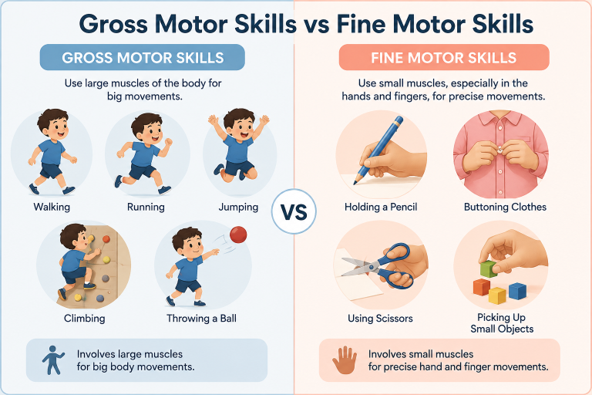
Gross Motor Skills vs Fine Motor Skills

Picture1

Gross Motor Skills Milestones by Age

Keep in mind that every child moves at their own pace — these milestones are general markers, not strict checkpoints. How a child is developing overall usually tells you more than how they’re doing on any one skill.

Infants: Babies slowly gain control of their head and neck, learn to roll over, sit more steadily, and eventually start finding ways to move around on their own.

Around 1 year: This is often when children start pulling themselves up, standing while holding onto something, and taking those first wobbly independent steps.

Around 2 years: Walking becomes more confident, and many children start running, climbing and kicking a ball around this stage.

Around 3 years: Balance and coordination keep improving. Children may start jumping, tackling stairs with more confidence, and getting more involved in active games.

Around 4–5 years: Coordination tends to come together for running, jumping, hopping, throwing and catching. Many children can also balance on one foot and handle playground equipment more confidently.

There’s a lot of natural variation from one child to the next  so if something’s on your mind about your child’s development, it’s better to talk it through with a qualified professional than to measure them against other kids.

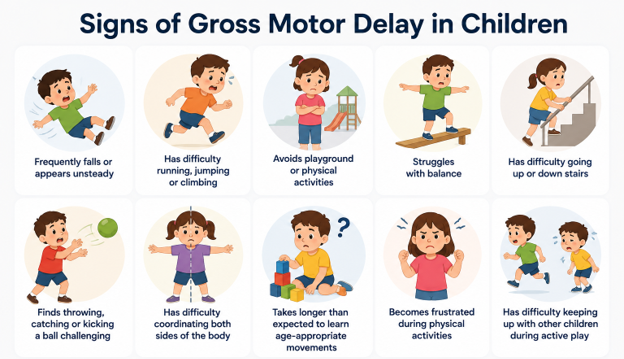
Signs of Gross Motor Delay in Children

Picture2

One sign on its own does not necessarily mean there is a developmental problem. What matters is whether difficulties are persistent and affect the child’s daily activities, play or independence.

Concerned about your child’s movement or coordination? A professional assessment can help identify their strengths and support their development.

How Occupational Therapy Can Help With Gross Motor Skills

When a child keeps struggling with movement, an Occupational Therapist (OT) doesn’t just look at one skill in isolation  they look at how that difficulty shows up in the child’s everyday life.

An assessment might cover things like:

  • Balance and coordination
  • Body awareness
  • Motor planning
  • Postural control
  • Strength and movement
  • Sensory processing
  • How the child participates in play and daily activities

From there, the therapist puts together a plan built around that particular child — their needs, their abilities, what’s actually going to help.

A lot of the work happens through play. Kids practise movement, coordination, balance and motor planning in ways that feel like fun rather than a task to get through.

And it’s worth saying occupational therapy isn’t about getting every child to hit the same milestone at the same age. It’s about helping a child feel more comfortable and confident doing the things that matter to them.

Conclusion

Gross motor skills are a big part of how children grow — helping them move confidently, join in on play and become more independent along the way.

Every child develops at their own pace. Still, ongoing trouble with balance, coordination, running or jumping is worth paying attention to. Catching it early gives parents a clearer sense of what their child needs, and whether extra support could help.

Most of all, movement should stay fun. With encouragement, plenty of active play and the right guidance when needed, kids can keep building both their physical skills and their confidence.

Is your child struggling with balance or coordination? A developmental assessment can help identify their needs and support their progress.

FAQs

What are gross motor skills in children?

Gross motor skills are the big movements that come from the large muscles walking, running, jumping, climbing, balancing and throwing.

Gross motor skills involve big, whole-body movements. Fine motor skills are the smaller, more precise ones, mainly using the hands and fingers.

Running, dancing, climbing, ball games, obstacle courses, hopping and balance games are all simple ways to build gross motor skills through play.

Children develop at different paces, but if your child often struggles with age-appropriate movements, falls frequently, avoids physical play, or has trouble with balance and coordination, it’s worth speaking to a professional.

Yes. An Occupational Therapist can work on coordination, balance, motor planning and body awareness, with a plan tailored to your child’s needs.

References

  1. https://my.clevelandclinic.org/health/articles/gross-motor-skills
  2. https://help-for-early-years-providers.education.gov.uk/areas-of-learning/physical-development/gross-motor-skills

Disclaimer: This blog is for informational purposes only and is not a substitute for professional medical advice.
Why Do Some Children Walk on Their Toes?

Why Do Some Children Walk on Their Toes?

Toe walking in toddlers is common while a child is still building balance and coordination, so a phase of it isn’t automatically something to worry about. But when it sticks around past the toddler years, the causes of toe walking in children can range from plain habit to muscle tightness, sensory sensitivity or an underlying developmental factor worth a proper look.

According to Dr. Sushant D. Sarang, Occupational Therapist in Navi Mumbai at Tender Touch Therapy Clinic, “Parents get told to just wait it out, and sometimes that’s right. But past age three, or when it’s constant, it’s worth checking whether the ankle, the nervous system, or something else is behind it.”

What Are the Common Causes of Toe Walking in Children?

Not every child toe walks for the same reason, and the reason usually shapes what comes next.

  • Idiopathic toe walking: No clear cause, no other symptom, just a habit that stuck since the child’s first steps. Most common type by far.
  • Sensory sensitivity: Some kids toe walk because the soles of their feet register touch or pressure differently, so full-foot contact feels overwhelming rather than steady.
  • Tight calf muscles: A shortened Achilles tendon or tight calf muscles can make heel-down walking physically uncomfortable, not just unfamiliar.
  • Underlying developmental conditions: Autism spectrum disorder, cerebral palsy and certain muscular conditions can all show up first as toe walking, long before anything else gets noticed.

A sensory integration therapy assessment can pinpoint which of these is actually driving the pattern.

How Is Toe Walking in Toddlers Different From a Lasting Problem?

A toddler on their toes isn’t automatically a red flag. Age and consistency change the picture completely.

Feature

Typical Toddler Toe Walking

Toe Walking That Needs Attention

Age range

Under 2 to 2.5 years

Persists past age 3

Consistency

On and off, mixed with normal walking

Almost every step

Ankle flexibility

Full range of motion

Tight, resistant to stretching

Other developmental signs

None

Speech delay, sensory issues or motor delays present

  • Age tells half the story: Most toddlers phase out of toe walking well before they start school. Past age three, it’s worth a proper look.
  • Occasional versus constant: A child who toe walks sometimes and walks flat the rest of the time is a different case than one who’s on their toes with almost every step.
  • Ankle flexibility matters: If the ankle stretches back easily, it’s likely a habit. If it resists, tightness is probably driving it, not choice.
  • Other signs change the picture: Toe walking alongside delayed speech, sensory sensitivities or motor delays points toward something beyond a passing phase.

Since gait and speech milestones often move together, our post on walk and talk delays covers the connection in more depth.

Why Choose Tender Touch Therapy Clinic for Kids Who Walk on Their Toes?

Dr. Sushant Sarang is a PhD Scholar in Occupational Therapy, with Sensory Integration certification,  from the USA, backing up the clinical side. Over 27 years in practice and 2 lakh plus sessions guided, he’s worked with a large numb. A team of 20+ therapists across four Navi Mumbai branches works alongside him, so a child’s assessment and plan stay consistent from the first visit onward. That consistency is what makes trust with a child rebuild slowly, one interaction at a time.

Toe walking past age three, worth a check or worth waiting out? Book an assessment to find out.

FAQs

Is toe walking normal in toddlers?

 Yes, it’s common up to age two or so and often fades naturally.

Past age three, or if it’s constant and paired with other delays.

 It can be an early sign, though most toe walkers are not autistic.


Stretching, sensory-based therapy or bracing, depending on what’s actually causing it 

1.PMC — Interventions for Idiopathic Toe Walking (Cochrane Review): https://pmc.ncbi.nlm.nih.gov/articles/PMC6778693

2.PMC — A Caregiver Survey on Medical and Behavior Analytic Treatments for Idiopathic Toe Walking: https://pmc.ncbi.nlm.nih.gov/articles/PMC11904036

Disclaimer: This blog is for informational purposes only and is not a substitute for professional medical advice.

What Is Selective Mutism in Children?

What Is Selective Mutism in Children?

Selective mutism isn’t a speech disorder, it’s anxiety. The child goes silent in specific settings, school, an unfamiliar relative’s house, new company, while speaking normally and comfortably at home. It typically starts early, right as a child begins facing new classrooms and new faces for the first time. The silence isn’t defiance or a mood, it’s a nervous system stuck in freeze mode the moment speech feels expected somewhere unsafe.

According to Dr. Sushant D. Sarang, Occupational Therapist in Navi Mumbai at Tender Touch Therapy Clinic, “Parents often assume their child is being difficult or overly shy. What’s actually happening is the anxiety response taking over the moment speech is expected outside home. It’s not defiance. It’s fear wearing a very quiet face.”

What Are the Signs of Selective Mutism in Children?

No two kids show it exactly the same way. Still, certain patterns turn up again and again.

  • Freezing in specific settings: Chatty at home, mute at school. Add unfamiliar relatives to the mix and the same shutdown happens. The switch happens instantly, not gradually.
  • Physical signs of anxiety: Watch the body before the words. A stiffened posture, eyes turned away, a blank stare, or clinging tight to mom or dad, these show up right before the silence sets in. The body reacts before the mind decides anything.
  • Communicating without words: A nod here, a point there, maybe a whisper to just one trusted person. Speech gets replaced with gesture, and that becomes the norm. Some children freeze entirely, movement included.
  • Persistence past the first weeks: A quiet start to a new school year is normal. Selective mutism runs longer, a month or more, and it starts chipping away at schoolwork and friendships. That’s the line worth watching.

A focused behavioral therapy plan builds speech confidence right in these settings, not somewhere else.

How Is Selective Mutism Different From Normal Shyness?

Most parents wait it out first, chalking it up to shyness. But the two behave very differently underneath the surface.

Feature

Shy Child

Child with Selective Mutism

Warms up over time

Yes, usually within minutes

No, silence persists across repeated visits

Speaks in a new setting eventually

Yes

Rarely, without targeted support

Body language

Slightly reserved

Frozen, anxious, sometimes rigid

Impact on school or friendships

Minimal

Often significant

  • Time alone doesn’t fix it: A shy child eases up after a few visits to the same place. A child with selective mutism can sit through an entire term in the same classroom and still never say a word to the teacher.
  • The freeze response runs deeper: Shyness feels like discomfort. Selective mutism is closer to panic. The body locks the words in, it doesn’t just hold them back.
  • School performance often suffers: Teachers sometimes mistake the silence for disinterest or low ability. It’s neither. Participation and grades slip for reasons that have nothing to do with intelligence.
  • Friendships take longer to build: Kids nearby read the silence as unfriendliness, though that’s rarely what’s going on. Kids with selective mutism usually want to connect. The anxiety just gets there first.

So can therapy actually shift this? Our piece on behavioral therapy sessions shows the same approach helping kids build this exact kind of confidence.

Why Choose Tender Touch Therapy Clinic?

Dr. Sushant Sarang is a PhD Scholar in Occupational Therapy, with Sensory Integration certification, from the USA, backing up the clinical side. Over 27 years in practice and 2 lakh plus sessions guided, he’s worked a large number of children  carrying anxiety-driven speech difficulties like this. A team of 20+ therapists across four Navi Mumbai branches works alongside him, so a child’s plan stays consistent from one session to the next. That consistency is what makes trust with a child rebuild slowly, one interaction at a time.

Every child presenting with ADHD starts with a full assessment before any programme is designed. It identifies which specific patterns are causing the most disruption and what combination of approaches is most likely to produce change. Parents are involved from the beginning and receive guidance on carrying strategies into daily life at home. What is not working gets replaced.

Chatty at home, silent at school, does that sound like your child? A proper assessment can tell you why.

FAQs

At what age does selective mutism usually show up?

 Usually between three and five, right when a child’s social world widens.

 No. It’s an anxiety disorder, and it can exist with or without autism.

 Some kids improve on their own, but therapy speeds things up and prevents relapse.

Depends on the child, but most parents see progress within a few months.


  1. PMC — Selective Mutism: A Review of Etiology, Comorbidities, and Treatment: https://pmc.ncbi.nlm.nih.gov/articles/PMC2861522/
  2. PMC — Children of Few Words: Relations Among Selective Mutism, Behavioral Inhibition, and Social Anxiety Symptoms: https://pmc.ncbi.nlm.nih.gov/articles/PMC4712224/

Disclaimer: This blog is for informational purposes only and is not a substitute for professional medical advice.
4a825667 cac1 43e8 8b9d 51827fdc91e0 1200x500

Play Therapy for Autism | Benefits & Activities for Children

Is your child finding it difficult to communicate, interact with others, or engage in everyday play? If your child has Autism Spectrum Disorder (ASD), you may be wondering which therapies can help them build essential life skills. Occupational therapists may use play as a therapeutic medium to help children develop these skills in a natural and engaging way.

Through structured and purposeful play-based activities, occupational therapists can support children in developing communication and social skills, regulating their emotions, and processing sensory information. Children often learn through play in a way that feels relaxed, engaging, and motivating, making it easier to practise and develop everyday life skills.

Play is a beneficial and engaging therapeutic medium used by occupational therapists to help children with autism develop communication, social, emotional, and everyday life skills.— Dr. Sushant Sarang | PhD. Navi Mumbai, Scholar & Senior Occupational Therapist.

If you’re exploring therapy options for your child, understanding how play therapy works can help you decide whether it is the right step for your family’s journey.


Understanding Autism Spectrum Disorder (ASD)

Autism Spectrum Disorder (ASD) is a developmental disorder that affects how a child communicates, interacts with others, learns, and experiences the world. Since autism is a spectrum, every child has unique strengths and challenges.

Some common signs of autism include:

  • Late talking or language delays
  • Limited eye contact
  • Social skills problems
  • Repetitive behaviours or movements
  • Preference for routines
  • Sensitivity to sound, light, texture or touch
  • Limited ability in imaginative or pretend play

Early intervention can make a big difference. As part of occupational therapy, play can be used as a therapeutic medium to help children build communication, social, sensory, and everyday life skills.

Benefits of Play Therapy for Children with Autism

Occupational therapists use play as a therapeutic medium to help children with autism build essential life skills through enjoyable and meaningful activities.

  • Encourages Better Communication

Through play therapy, children can communicate their thoughts and needs via gestures, facial expression, toys, pictures and verbalization. As time passes, many children are more confident in communicating with others.

  • Strengthens Social Skills

Children learn important social skills such as taking turns, sharing, following simple instructions, and playing with others. These skills gradually carry over into everyday situations at home and school.

  • Supports Emotional Regulation

Through guided play, children learn to recognise and express their emotions while developing healthy ways to cope with frustration, anxiety, and changes in routine.

  • Encourages Creativity

Through activities such as stories, role play and pretend play children learn to think flexibly and be imaginative in their problem solving skills.

  • Improves Sensory Processing

Sensory activities such as water play, play dough, sensory bins, and textured toys help children become more comfortable with different sensory experiences while improving focus and coordination.

  • Develops confidence and independence

Children feel more confident about themselves as they make small steps during therapy and are more likely to attempt new activities and to increasingly become independent in everyday life.

Could Play Therapy Make a Difference for Your Child?

Give your child the opportunity to learn, communicate, and grow through play. Book an assessment to find the right therapy plan for their unique needs.

How Occupational Therapists Use Play in Therapy

A2890bbe 59a0 4358 a854 4566379f8216

Occupational therapists use play-based activities as a therapeutic medium, selecting activities based on each child’s individual needs, interests, abilities, and developmental goals.

Initial Assessment

The therapist first understands your child’s strengths, challenges, interests, and developmental milestones to develop a personalised therapy plan.

Engaging Play Activities

Structured and child-led play activities encourage communication and social interaction, sensory development and problem-solving skills.

Skill Building

The therapist, throughout the session, gently supports the child to practice new skills and to make learning fun and low stress.

Parent Involvement

Parents are provided with easy-to-follow strategies and activities to foster continuing progress at home.

Progress Monitoring

The therapist regularly reviews your child’s development and adjusts the therapy plan as new goals are achieved.

Conclusion

Play is a safe and enjoyable therapeutic medium that occupational therapists can use to support communication, social interaction, emotional regulation, sensory processing, and daily functioning in children with autism. Each child will progress at their own rate, and an individualised therapy programme will help each child reach his/her potential. Play therapy is a great experience for children and if understood during their early stages in a consistent and supportive way, can be utilized as they grow.

Help Your Child Learn Through Play

Early help can make a difference. Make an appointment for your child to utilize the power of play to learn, grow and thrive.

FAQs

When does a child begin play therapy?

Early intervention generally leads to the best outcomes. Play therapy can be started at the time developmental concerns are first identified, but may be used with children of all ages.

The frequency will be based on your child’s needs and the therapist’s recommendations. Children usually come to 1 or 2 sessions per week.

Absolutely. The therapist will also have a major responsibility for encouraging parents to follow his or her advice and to practise simple activities at home that reinforce the new skills.

Yes. This therapy is frequently used in conjunction with other therapies such as occupational therapy, speech therapy, sensory integration therapy and others to assist the child’s overall development.


References

https://pmc.ncbi.nlm.nih.gov/articles/PMC9850869/

https://autismspectrumnews.org/is-play-therapy-an-evidenced-based-intervention-for-children-with-autism/

Disclaimer: This blog is for informational purposes only and is not a substitute for professional medical advice.
Picture1

Occupational Therapy for Feeding Challenges

Occupational Therapy for Feeding Challenges

Does your child refuse certain foods, gag while eating, or take a long time to finish meals? While picky eating is common, ongoing feeding difficulties may affect your child’s growth and nutrition.

Occupational therapy helps children improve eating skills, become more comfortable with different foods, and enjoy mealtimes with greater confidence. With the right support from a Child Development Center, eating can become easier and less stressful for both children and parents.

“Eating should be a positive experience for every child. With the right support, children can build the skills and confidence they need to enjoy mealtimes and develop healthy eating habits.”— Dr. Sushant Sarang | PhD, Scholar & Senior Occupational Therapist, Navi Mumbai

Common Feeding Challenges in Children

Every child is different, but some feeding problems may need professional support if they continue over time. Common challenges include:

  • Refusing to eat certain textures or food groups
  • Gagging or coughing while eating
  • Difficulty chewing or swallowing food
  • Taking more than 30–40 minutes to finish a meal
  • Eating only a very limited variety of foods
  • Trouble transitioning from liquids to solid foods
  • Avoiding self-feeding
  • Becoming upset or anxious during mealtimes

If these difficulties continue, they may affect your child’s nutrition, growth, and overall development.

How Occupational Therapy Helps Children With Feeding Challenges

Children peel and snack on oranges at a white table, guided by an adult in a bright classroom kitchen setting

Occupational therapy helps improve the skills needed for eating. Every therapy plan is personalized to your child’s needs and supports progress at a comfortable pace.

Improves Oral Motor Skills

Children are taught to build up the strength of chewing, biting and swallowing muscles which facilitates and makes eating easier and safer.

Reduces Sensory Sensitivities

Some children reject foods due to their texture, smell or temperature. During therapy, children are gradually introduced to different food textures, smells, and tastes to help them feel more comfortable trying new foods.

Encourages Self-Feeding

Therapists help children improve hand coordination and grip so they can feed themselves more confidently.

Builds Positive Mealtime Habits

Children learn to sit comfortably, focus during meal times and establish healthy eating habits which help to minimise stress at home.

Expands Food Choices

Through gradual exposure and positive reinforcement, children slowly become more willing to accept new foods without pressure.

Techniques Used in Occupational Therapy for Feeding Challenges

Occupational therapists use safe, evidence-based techniques that are tailored to each child’s needs.

Some commonly used approaches include:

  • Oral motor exercises to improve chewing and swallowing
  • Sensory integration activities for children with food sensitivities
  • Gradual exposure to new foods
  • Food chaining to slowly introduce similar foods
  • Positioning techniques for comfortable eating
  • Adaptive utensils when required
  • Parent guidance and home strategies to continue progress outside therapy

The aim is to help children feel comfortable, confident, and successful during mealtimes, while gradually developing positive eating skills.

What Happens During an Occupational Therapy Feeding Assessment?

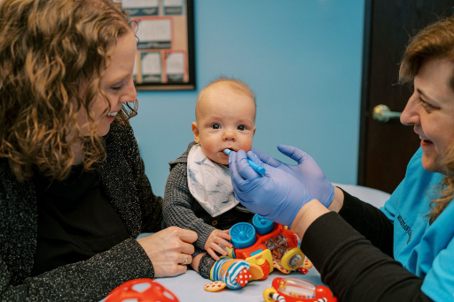
Infant sits on a table during a pediatric checkup as a clinician in blue gloves examines the baby's mouth with parents watching kindly nearby

The first assessment helps the therapist understand why your child is experiencing feeding difficulties.

A feeding assessment usually includes:

Understanding Your Child’s History

The therapist talks to you and your child about their feeding practices, growth and development milestones, health history and your concerns as a parent.

Observing Mealtime Skills

Your child could be observed when eating to see how they chew, swallow, hold their head up and their eating habits.

Sensory and Oral Motor Evaluation

The therapist checks how your child responds to different food textures, tastes, and sensory experiences while assessing the muscles involved in eating.

Personalised Therapy Planning

An individual therapy plan is developed based on the assessment; the goals are realistic and achievable for your child.

Benefits of Occupational Therapy for Feeding Challenges

With regular therapy and family involvement, children can experience meaningful improvements over time.

Some of the benefits include:

  • Better chewing and swallowing skills
  • Improved nutrition and healthy growth
  • Greater willingness to try new foods
  • Reduced anxiety around mealtimes
  • Better sensory processing
  • Increased independence while eating
  • More enjoyable family mealtimes
  • Greater confidence in everyday activities

Every child progresses differently, but consistent therapy and support can help build lifelong eating skills.

Conclusion

Eating problems can be frustrating for children and parents, but with the right support, they do not have to be a long-term struggle. Through occupational therapy, children can develop the skills and strategies they need to eat safely, comfortably, and with greater confidence.

Early support, personalised therapy, and guidance at home can help children feel more confident during mealtimes. With early intervention and consistent support, children can develop positive eating experiences and healthy lifelong eating habits.

FAQs

Can occupational therapy help picky eaters?

Yes. Occupational therapy can help children who have feeding difficulties due to sensory issues, oral motor challenges, or anxiety around food. The therapist identifies the underlying cause and creates a personalised treatment plan.

Early intervention usually gives the best results. However, feeding therapy can benefit toddlers, preschoolers, school-aged children, and even older children who continue to experience feeding challenges.

The duration depends on your child’s specific needs and progress. Some children improve within a few months, while others may benefit from longer-term therapy.

The duration depends on your child’s specific needs and progress. Some children improve within a few months, while others may benefit from longer-term therapy.

Yes. There is an important role of parents in feeding therapy. Therapists share practical skills that can be used at home to help maintain progress.

Can Behavioral Therapy Help Children with ADHD — T3 Clinic Navi Mumbai

Can Behavioral Therapy Help Children with ADHD?

Behavioral therapy is a structured, evidence-based intervention for children with ADHD that targets specific behavioural patterns through skill-building, routine reinforcement and caregiver training. It does not cure ADHD. What it does is replace patterns that are not working with habits that are, giving the child a better chance of functioning well at home and in school. For many families, it is the intervention that makes daily life manageable before anything else does.

According to Dr. Sushant D. Sarang, Occupational Therapist in Navi Mumbai at Tender Touch Therapy Clinic, “Behavioral therapy works best when it is specific to the child’s actual daily challenges. General strategies applied broadly rarely stick. Targeted approaches tied to real situations do.”

What Does Behavioral Therapy Actually Do for a Child with ADHD?

The goal is not to suppress the child’s energy or change who they are. It is to give them a workable set of responses to situations where ADHD creates the most friction.

Slowing reactive patterns: Before a child with ADHD can respond differently, they need a pause that does not come naturally. That pause is what behavioral therapy builds — slowly, through repetition, until it starts to happen without being prompted.

Routine and structure: A predictable sequence reduces the number of real-time decisions a child has to make. Mornings, homework and bedtime become less volatile when the steps are fixed and familiar rather than negotiated from scratch every day.

Positive reinforcement: Most reward systems fail children with ADHD because the reward comes too late or is too vague to land. Therapy gets specific — the right behaviour, the right response, immediately. Caregivers learn to apply this consistently rather than inconsistently, which is where most home attempts break down.

Caregiver involvement: What happens in the session matters less than what happens every other hour of the day. Parents and teachers learn to respond to difficult behaviour in ways that reduce escalation. That one change — how the adults in the room react — shifts the pattern faster than anything done only in a clinic.

Children with ADHD who also have sensory or motor difficulties respond better when behavioral therapy runs alongside occupational therapy. For children where ADHD is affecting daily function, OT for ADHD addresses the regulatory gaps behavioral strategies alone cannot reach.

How Does Behavioral Therapy Change Daily Life for Families?

Families living with ADHD tend to describe the same handful of breaking points. Mornings derail before 8am. Homework drags into the evening. Any change in plan triggers a meltdown. Bedtime becomes its own battle. Behavioral therapy does not promise to eliminate any of this. What it does is make each of these situations more manageable, one at a time.

The morning tends to shift first. The routine becomes fixed enough that the child can move through it without an adult directing every step. It does not happen quickly but when it does the whole household notices.

Homework is slower to change. A session with a clear start, a time limit and something the child actually wants attached to finishing it works differently to sitting at a desk until it is done. The ADHD brain needs an edge to run toward, not an open-ended instruction to persist.

Transitions catch most families off guard — the gap between one activity and the next is where ADHD children fall apart most visibly. A consistent warning, a predictable cue and the same expectation every time reduces that friction significantly. Not because the child suddenly handles change better but because the change stops being a surprise.

What builds underneath all of this is something harder to name. Fewer standoffs. Less daily conflict. A child who is not constantly failing at things that seem simple. That shift changes how the family functions and how the child sees themselves. For a detailed look at what targeted therapy delivers for children with ADHD, OT benefits ADHD covers the functional gains in depth.

Why Choose Tender Touch Therapy Clinic?

Dr. Sushant D. Sarang holds a PhD in Occupational Therapy and Sensory Integration certification at Level I and IV from the USA. T3 Clinic has been running since 2007 across four Navi Mumbai locations, with six therapists working exclusively with children and over 2 lakh sessions delivered.

Every child presenting with ADHD starts with a full assessment before any programme is designed. It identifies which specific patterns are causing the most disruption and what combination of approaches is most likely to produce change. Parents are involved from the beginning and receive guidance on carrying strategies into daily life at home. What is not working gets replaced.

If your child is struggling with ADHD and daily routines are breaking down, an assessment gives you a clear starting point. Book a consultation with T3 Clinic today.

FAQs

At what age can behavioral therapy start for a child with ADHD?

 As early as age three, though at that age the work is almost entirely with the parents rather than the child directly. Sessions become more structured and skill-based as the child gets older.

For younger children it is usually the first recommendation before medication is on the table. Some families find it enough on its own. Others combine it with medication and find the two work better together than either does alone.

Eight to twelve weeks of consistent sessions is the window where most families start seeing real change. How fast things move depends on how severe the difficulties are and how reliably strategies are applied at home and school between sessions.

Behavioral therapy works on responses, habits and how the people around the child manage difficult situations. Occupational therapy goes a level deeper — to the sensory and regulatory gaps that are driving the behaviour in the first place. Most children with ADHD do better with both.

References

  1. Improving the Efficacy of Evidence-Based Psychosocial Interventions for ADHD in Children. PMC — https://pmc.ncbi.nlm.nih.gov/articles/PMC11162428/
  2. Effective Approaches to Managing Behavioral Problems in Children with ADHD: A Narrative Review. PMC — https://pmc.ncbi.nlm.nih.gov/articles/PMC12923175/

Disclaimer: This blog is for informational purposes only and is not a substitute for professional medical advice.